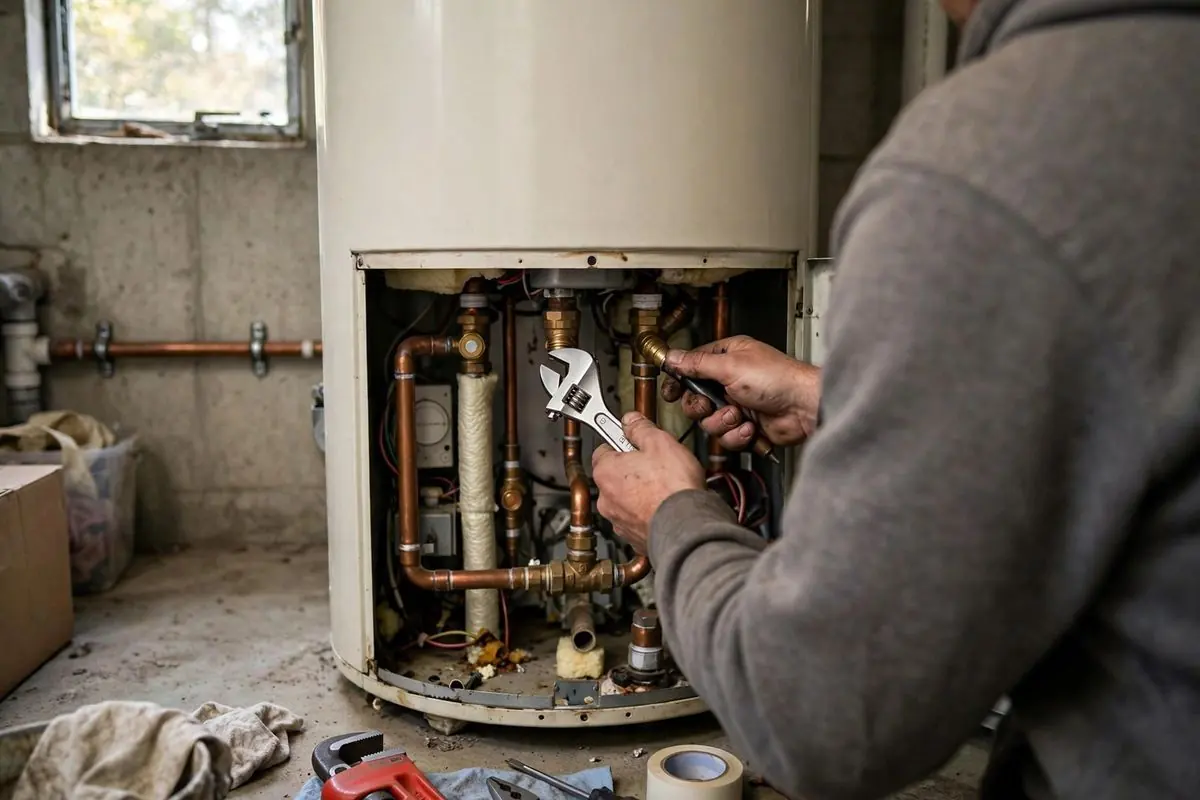
If water is on the floor now
Take these steps first.
Switch the breaker off for electric heaters. For gas, turn the control to off or pilot.
It is on the pipe above the heater. Turn it clockwise.
Do not stand in water near an electric heater or panel.
A leaking tank can empty 40 or more gallons onto the floor.
Where the water is coming from
| Where it leaks | Likely cause | Fixable? |
|---|---|---|
| Top of the tank at the pipes | Loose or corroded inlet or outlet fittings | Yes, often. |
| Pressure relief valve or its pipe | Worn valve or high pressure | Yes. See water heater repair. |
| Drain valve at the bottom | Worn valve seat | Yes, replace the valve. |
| Base of the tank, flowing | Corroded tank | No, replace the heater. |
| Water on the floor, source unclear | Condensation or a nearby pipe leak | Depends, find the source. |
| Gas heater, wet in the burner area | Condensation or a heat exchanger crack | Needs a technician. |
A leak from the tank body itself cannot be patched. If water comes from the bottom of the tank, plan for replacement.
How to find the leak without guessing
Dry the area with a towel and watch where the first drop appears. Check the pipes above the heater and the pressure relief valve first, because those are the cheapest to fix. Look inside the burner access panel, if your heater has one. Rust streaks on the tank, dampness around the base and a rusty puddle all suggest the tank is failing.
A tank that is over ten years old and leaking from the bottom is nearly always at the end of its life. The inside of the tank is steel, and the anode rod that protects it wears out. Once the lining goes, the tank rusts through from the inside. A new anode rod can extend a healthy tank, but it cannot fix a tank that has already started leaking.
Leaks that are repairable
- Supply line connectionsFlexible connectors wear out. New ones fix the leak in minutes.
- Pressure relief valveA worn or crusted valve can be replaced in a short visit, once the cause of the drip is known.
- Drain valveA cheap valve at the bottom can weep. A plumber can swap it.
- Expansion tankA waterlogged or leaking expansion tank can be replaced.
- Dielectric nipplesCorroded nipples at the top of the tank are replaceable.
Want a plumber to handle it?
Call and a person answers, any hour. You hear the price before any work starts.
What the City of Milpitas expects when a tank is replaced
If the tank has to go, Milpitas requires a plumbing permit for the replacement. According to the city's guidance, the tank needs two seismic straps, a relief valve piped to a safe discharge, and a seismic gas shutoff valve where gas is used. A thermal expansion tank is required where the system is closed.
If your garage heater is on the floor and the tank is leaking, the replacement may bring other code upgrades with it. Asking early prevents a failed inspection. See water heater replacement for how we handle the permit. For a house near the San Jose line, our San Jose service page explains the San Jose permit route.
Source type: City of Milpitas Office of Building Safety plumbing permit handout.
Repair or replace: the decision
If the heater is under eight years old and the leak is at a fitting or valve, repair is usually the better value. If the heater is ten years or older and water comes from the tank, replacement is the sensible choice. Between those ages, look at the whole picture, including rust in the hot water, rumbling noises and how often you have called for repairs.
A tank can fail slowly or all at once. A small leak can become a flood overnight. If you are unsure, shut the water off and have the heater inspected. We tell you plainly whether a repair makes sense, with no pressure to replace.
If the heater is borderline, we show you the rust, the sediment and the age on the data plate, so the decision rests on what you can see.
How to prevent the next leak
- Flush the tank once a yearIt clears sediment that traps heat at the bottom and wears the lining.
- Check the anode rod every few yearsIt is the sacrificial part that protects the steel. Replace it when it is mostly gone.
- Install a drain pan with a drain lineA pan catches a leak and sends it somewhere safe.
- Keep pressure under 80 psiHigh pressure stresses the tank and every fitting.
- Add an expansion tank in a closed systemIt absorbs the pressure spike that comes with each heating cycle.
- Replace flexible connectors that look corrodedThey are cheap and often the first to fail.
What a plumber does on a leak call
Locate the leak
Dry and trace each fitting and the tank body.
Test the pressure
A gauge on a hose bib shows incoming pressure, which affects the valve.
Explain the options
Repair, replace or monitor, with prices.
Do the work
Parts are swapped or the tank is replaced to code.
Test and clean up
Check every joint, test the valve and tidy the area.
Common Questions
Not the tank itself. Leaks at fittings or valves can be repaired, but a leak from the tank body means replacement.
It can be. Water near electrical parts is a shock risk, and a failing gas heater can be a fire risk. Turn off fuel and power and call.
A full tank holds 30 to 50 gallons or more. A slow leak can run for days before you notice.
Often the sudden water damage is covered and the heater itself is not. Check with your insurer.
Yes. Our line is open 24/7. Turn off the water and power first, then call.