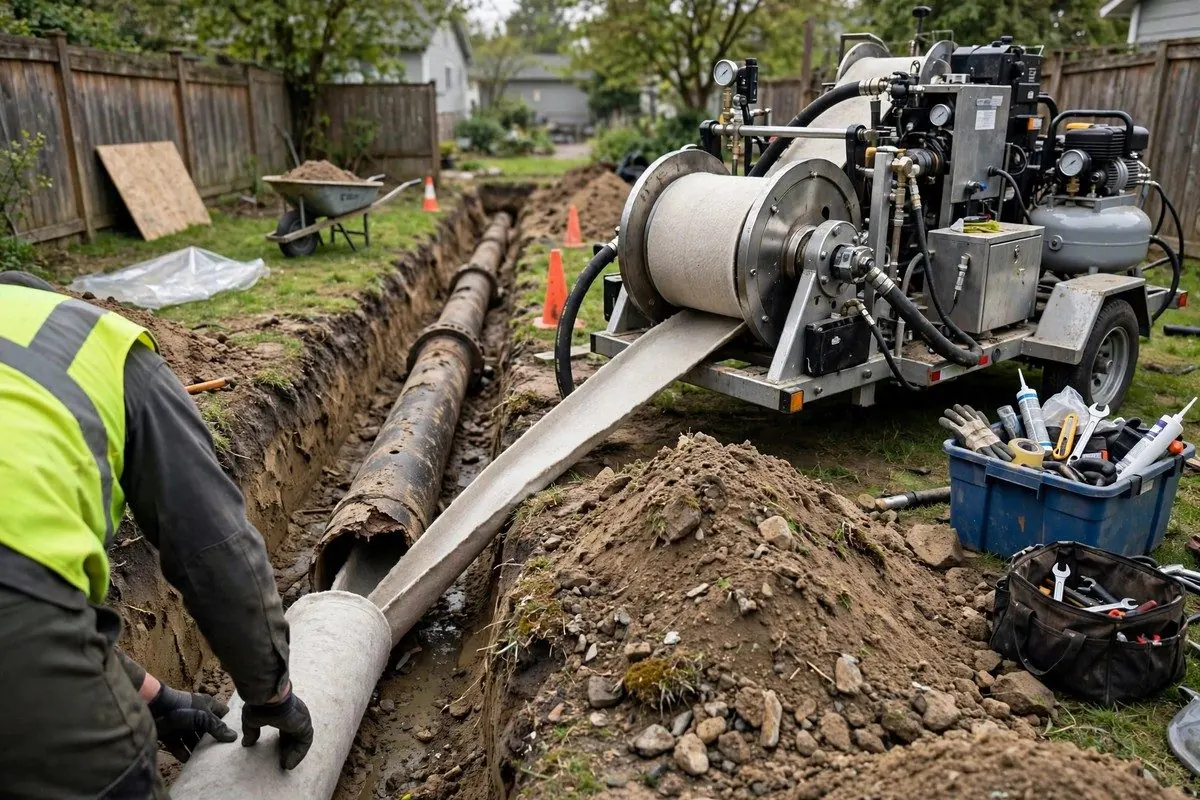
How a failing sewer line announces itself
Most failing laterals give notice for months. Drains slow, the toilet gurgles when the washer drains, a damp patch appears over the line, or a sewer smell shows up near the cleanout. A single backup can be a clog. Three backups in a year is a pipe problem.
The only way to be sure is a camera run, which shows cracks, offset joints, roots in the joints and bellies where water pools. See sewer inspection for how that works. The footage decides the repair method.
Repair options and when each one fits
| Method | What it is | Fits when | Does not fit when |
|---|---|---|---|
| Spot repair | Dig down, cut out the bad section and splice in new pipe | One short failed section, accessible location | Damage runs the full length of the line. |
| Trenchless lining | A resin liner is cured inside the old pipe | Cracks or root-entry joints in a pipe that still holds its round shape | Pipe is collapsed or badly compromised. |
| Pipe bursting | A bursting head pulls new pipe through the old path | Long run with limited yard access | Pipe has been repaired with point fixes that block the head. |
| Open-trench replacement | Dig the full run and lay new pipe | Collapsed, bellied or sagging pipe | Deep or crowded utility corridors. |
Milpitas Building Safety says trenchless replacement must follow ASTM F1216, that cured-in-place liners shall not be used on collapsed piping, and that cast-iron soil pipe is excluded from the trenchless method its handout describes.
What the city requires for a sewer line job
The city's handout for residential sewer line replacement covers the work between the building drain, 2 feet outside the building, and the public works encroachment line or back of the sidewalk.
- A permitThe permit may be issued to a state-licensed contractor with the proper classification, to the property owner or to the owner's designee. Work under a sidewalk or street needs an encroachment permit, obtained in person at the Permit Center.
- Approved pipeThe list includes ABS Schedule 40, PVC Schedule 40, cast iron, copper DWV and stainless steel 316L. All of it must be third-party listed.
- Slope and sizeSewers need a uniform slope of at least 1/4 inch per foot where practical, and a sewer serving one to three toilets cannot be smaller than 3 inches.
- TestingThe line is tested water-filled or with a low-pressure air test at 4.0 psi, and plastic DWV is not air-tested.
- Two inspectionsAn underground inspection with a camera on site, then a final once backfill is complete.
Sewer line failing?
Call now. We clear the stoppage tonight and plan the repair after a camera look.
Who owns the repair in Milpitas
The city says it maintains the public sanitary sewer, and that where a pipe in the public lateral section is broken or structurally failed, the City makes the repair at no charge. The private house sewer from the property line to the building belongs to the property owner.
This split makes the camera footage important. If the break is on the public side, the video is what you show the city. If it is on your side, the video is the basis for the repair plan and permit.
Older housing and the likely pipe
Milpitas incorporated in 1954, and the Sunnyhills tract was built for Ford plant workers in the 1950s. Homes from that era often have clay or cast iron laterals, with roots entering at joints. Later homes more often have ABS or PVC.
If you own a home from the first decades after incorporation, assume the lateral has never been replaced until a camera proves otherwise. The camera also tells you whether lining is possible. Roots are a good case for hydro jetting after a spot repair.
What drives sewer repair cost
Sewer repairs vary widely, so we quote only after the camera.
Many homeowners policies cover accidental damage but not wear on an old pipe. Ask your agent what yours says.
What to do first, and the code behind it
Stop using water in the house and keep people away from any sewage that has surfaced. Repairs follow the California Plumbing Code, which is based on the Uniform Plumbing Code (UPC), and according to the City of Milpitas Office of Building Safety, replacing drain piping requires a plumbing permit and an inspection before the trench is covered.
Common Questions
Yes. The line is open 24/7. We clear the stoppage to stop the overflow and schedule the repair after a camera look.
No. Lining needs a pipe that still holds its shape. Collapsed or badly offset pipe needs replacement, and the city bars liners on collapsed piping.
Replacing sewer line piping needs a plumbing permit according to the city handout. Clearing a stoppage is exempt, but replacing a failed drainpipe is new work.
Often yes. Roots can be cut and the joint lined if the pipe is round. Removing the tree reduces the chance of roots coming back.
Milpitas says it repairs a broken or structurally failed public lateral at no charge. Bring the camera video to the city.