How hard is Milpitas water
The City of Milpitas reports its water quality each year. Hardness reported in the city's consumer confidence report ranges from about 8.4 to 168 ppm, with averages around 57 to 110 ppm depending on the supply. That is roughly 3 to 6 grains per gallon on average, and softer than much of the country but enough to leave scale on fixtures over time.
Because the mix of sources changes through the year, your tap can run softer or harder in different months. A test at your own tap gives the figure that matters for your house, and the figure decides whether a softener is worth installing.
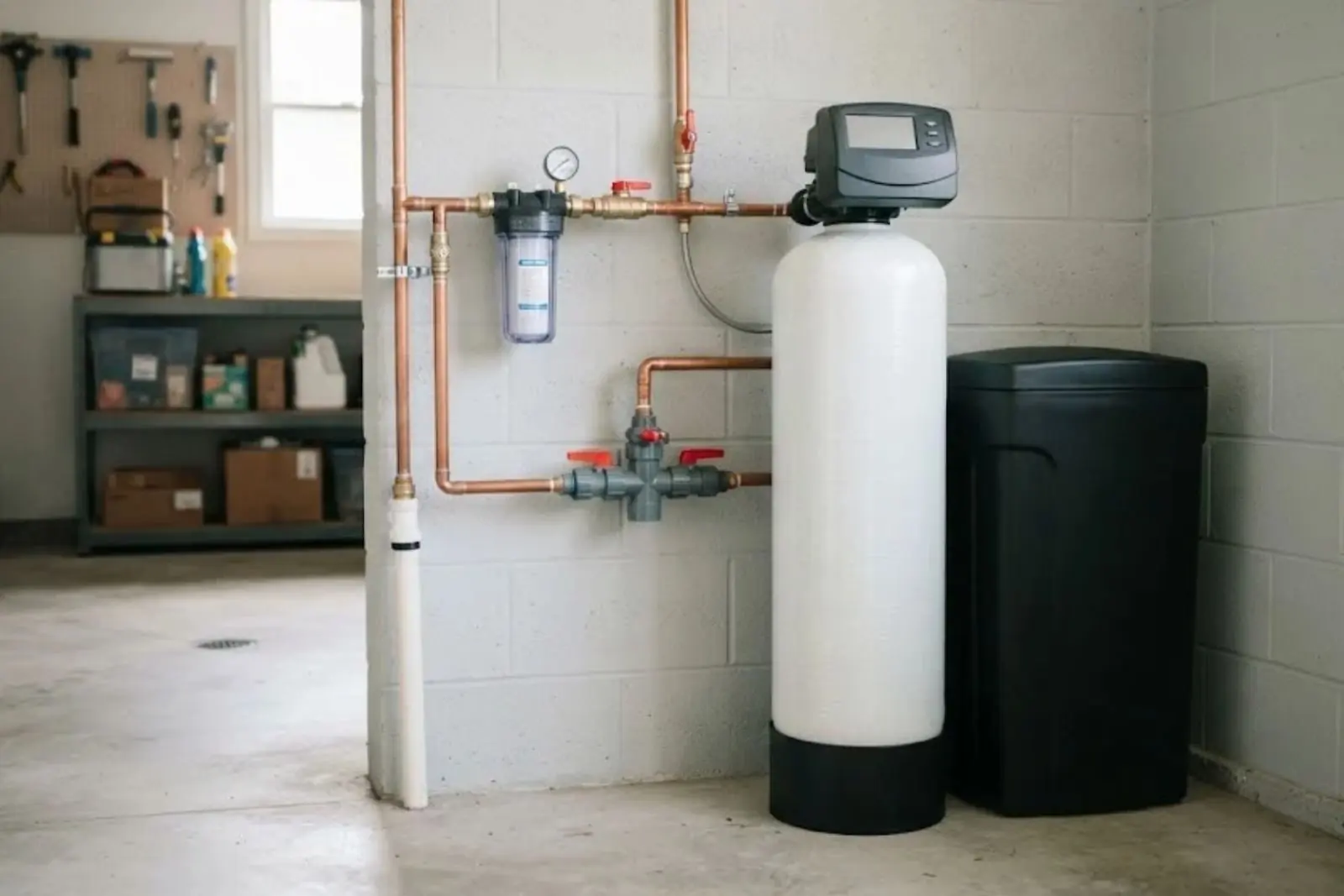
Softener, filter or both
| Option | What it does | Good for |
|---|---|---|
| Salt-based softener | Swaps calcium and magnesium for sodium to remove scale | Scale, spotting, soap use. |
| Salt-free conditioner | Changes how minerals stick, does not remove them | Light scale control with no salt. |
| Carbon filter | Reduces chlorine taste and odor | Taste and smell. |
| Sediment filter | Catches sand and particles | Cloudy water, older pipe flakes. |
| Reverse osmosis at one tap | Removes dissolved solids for drinking water | Drinking and cooking water. |
A softener does not make water drinkable or purer. Treat softening and filtering as two separate goals.
Signs hard water is costing you
- Scale on faucets and showerheadsWhite crust that returns days after cleaning.
- Spotted dishes and glassDishwasher residue even with rinse aid.
- Dry skin and stiff laundrySoap does not rinse fully in hard water.
- Noisy or inefficient water heaterScale builds on the tank bottom. See water heater repair.
- Falling pressure at fixturesScale narrows pipes and clogs aerators.
- Short life for appliancesScale shortens the life of heating elements.
Scale on your fixtures?
Call for a tap test and a clear price.
Things to know before you install a softener
A softener needs a drain for its regeneration water and an outlet. Some local water districts and cities have rules on salt-based softener discharge, so check with the city before you buy. We can tell you what to ask.
Softened water uses sodium. If anyone in the home follows a low-sodium diet, ask your doctor, and consider leaving the kitchen drinking tap on an unsoftened line. Also tell us if you have a tankless heater, since scale protection matters most there. See tankless water heaters.
Sizing a softener to your household
Capacity depends on how many people live in the home and how hard the water tests. A family of four with moderate hardness needs a smaller unit than a family of six with the harder end of the range. An oversized unit wastes salt and an undersized one regenerates too often.
We measure your tap hardness, ask about the number of bathrooms and check the space and the drain before recommending a size. We also look at the water heater, since scale protection helps most where water is heated.
What affects water treatment cost
You get a written price.
Sources for the water facts
Hardness figures come from the City of Milpitas annual water quality report. Certified products carry NSF/ANSI marks, and plumbing connections follow the California Plumbing Code, which is based on the Uniform Plumbing Code (UPC).
Common Questions
It varies. City reports show averages from about 57 to 110 ppm and a wide range. Many homes see some scale.
Not always. If scale is light, a filter or periodic descaling may be enough. A tap test tells us.
No. A carbon filter reduces chlorine taste and odor. A softener only removes hardness minerals.
Check the salt monthly. A service visit once a year keeps the valve and resin healthy.
Yes, if the model fits the space and the drain. Share the model first.