What baking soda and vinegar actually do
When baking soda meets vinegar it fizzes, and the fizz is carbon dioxide gas. That bubbling can loosen a thin film of soap or paper at the bowl outlet. It does not break up a solid clog of wipes, a toy or compacted paper. The reaction is also short, so it has little time to work before the mixture drains away.
The best use of the method is as a gentle first step on a slow toilet when nothing is obviously stuck. If the bowl is full to the rim, the method will not help, and adding more liquid can cause an overflow. Know which case you have before you start.
If the bowl is full or rising, stop first
Do these before anything else.
Another flush sends more water to the floor.
Turn the oval handle clockwise until it stops.
This stops the tank from refilling the bowl.
A full bowl often drains down slowly on its own. Do not add fluids until the level is below the rim.
How to try baking soda safely
Lower the water level
If the bowl is high, bail some water into a bucket. A bowl about half full is easiest to work with.
Add the baking soda
Pour in about a cup and let it settle into the bowl.
Add the vinegar
Pour in about two cups slowly. Expect fizzing.
Wait
Give it 20 to 30 minutes, then pour in a pail of hot (not boiling) tap water from waist height.
Plunge
A flange plunger, which has an extra rubber lip, seals the bowl outlet better than a flat cup plunger.
Flush once
If the bowl drains normally, flush once to test. If not, stop.
Home remedies compared
| Method | What it does | Works best on | Risk |
|---|---|---|---|
| Flange plunger | Moves the clog with pressure and suction | Most single-fixture clogs | Low. |
| Baking soda and vinegar | Fizz loosens a thin film | Mild slow drains | Low, but weak. |
| Hot water and dish soap | Softens and lubricates | Paper and soap clogs | Low (never boiling). |
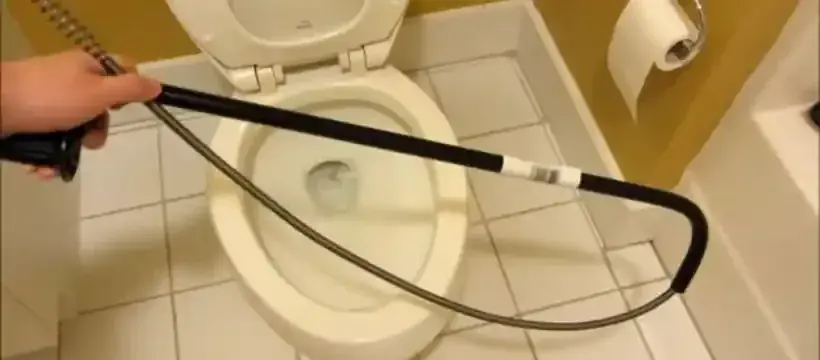
| Toilet auger | Reaches and breaks the clog | Stubborn bowl clogs | Can scratch porcelain. |
| Chemical drain cleaner | Eats organic matter | Not recommended in toilets | High: can damage pipes and burn skin. |
Never mix drain cleaners with vinegar or baking soda, and never plunge after pouring in a chemical cleaner.
Want a plumber to handle it?
Call and a person answers, any hour. You hear the price before any work starts.
What causes toilet clogs in the first place
Too much paper is the usual reason. Flushable wipes, paper towels, cotton swabs and feminine products do not break down like toilet paper. They catch in the trap and build up. A low-flush toilet that is more than ten years old can also struggle to move waste, because the bowl does not carry enough water.
If several toilets and drains in the house are slow at once, the clog is not in the toilet. It is in the shared branch or the main sewer line. In that case, no home remedy will help, and the sensible step is a professional cleaning. See drain cleaning and sewer camera inspection.
What this means for a Milpitas house
Most Milpitas homes connect to the city sewer rather than a septic tank, so a clog that backs up beyond the toilet can involve the line that runs under the street. The city's permit handout makes clear that repairs which do not replace or rearrange pipes are exempt from a permit, so unclogging is simple, but replacing a section of line is permit work.
Older homes from the 1950s and 1960s often have clay or cast iron drain lines that collect roots and scale. If you have a mature tree near the sewer lateral, repeat clogs may be a sign of root intrusion. A camera shows it in minutes. If you live on the North San Jose side of the boundary, see our San Jose service page for the permit rules there.
A toilet that rocks, leaks at the base or runs all the time is a different problem, covered under toilet repair and installation.
Source type: City of Milpitas Office of Building Safety plumbing permit handout.
Signs it is time to call a plumber
- Plunging does not move itAfter three or four rounds, the clog is beyond the plunger.
- Water rises in the tub or shower when you flushThat means the blockage is in the shared drain, not the toilet.
- Gurgling from other drainsAir is being pushed through traps by a downstream blockage.
- The clog keeps returningA repeat clog means something is building up or a pipe is damaged.
- Sewage smell or standing water on the floorStop using water and call.
- A toy or object went downAn auger can push it deeper. A plumber can retrieve it.
How to prevent the next one
Flush only toilet paper and human waste. Keep a small trash can with a lid near the toilet for everything else. Use a plunger at the first sign of slowness rather than waiting. If your toilet clogs often, ask a plumber to check the bowl and the flange, because a poorly set toilet or an older design may need replacement.
We handle after-hours toilet overflows 24/7. If the bowl is rising and the valve will not close, call (510) 544-1962 and we send a plumber.
Sources
Drain and fixture rules mentioned here follow the California Plumbing Code, which is based on the Uniform Plumbing Code (UPC), according to the City of Milpitas Office of Building Safety.
Common Questions
It can loosen a mild film but rarely clears a real blockage. A flange plunger is more reliable.
Chemical cleaners are not recommended. They can damage the bowl and pipes and are hazardous if they splash.
No. Boiling water can crack porcelain. Use hot tap water instead.
A partial blockage or an older low-flow design can make clogs intermittent. A camera check or a new toilet may be needed.
It becomes one if the bowl is rising or sewage is on the floor. Close the valve behind the toilet and call.