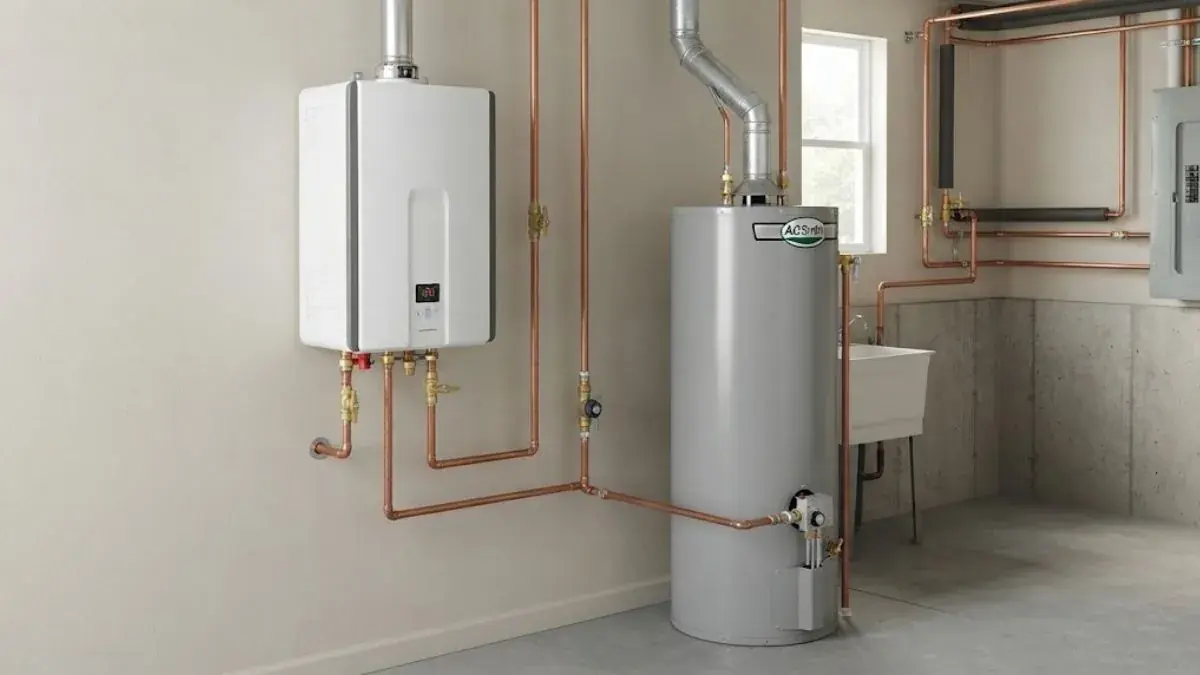
Con 1: the install is a bigger job than a swap
A tank heater is a plug-and-play appliance. A tankless unit usually is not. A gas tankless unit needs a larger gas line than most tank heaters because it burns a lot of fuel at once. It also needs special venting, since the exhaust is hot and moist. In many houses the old flue cannot be reused, so a new vent has to be run through the wall or roof.
Electric tankless units pull a lot of current. Whole-house electric models can require a heavy-gauge circuit and sometimes a panel upgrade. If your service panel is already full, the cost of the electrical work can exceed the price of the heater. Ask for the gas line and venting scope in writing before you choose a model.
Con 2: cost is higher up front
A tankless heater costs more to buy and more to install than a tank. The savings come later, from lower fuel use and a longer service life, and they take years to repay the difference. If you plan to move in a few years, you may not see the benefit.
The size of the payback depends on how much hot water your household uses. A household of two with short showers saves less than a household of five that runs the dishwasher, washer and two showers back to back. Ask any installer for a clear, itemized quote so you can compare it with a tank replacement. See water heater replacement for the tank side of that comparison.
Tankless against tank: the honest comparison
| Question | Tankless | Tank |
|---|---|---|
| Hot water supply | Unlimited in a single run, within flow limits | Limited by tank size, then a recovery wait. |
| Space | Wall-mounted, small | Floor space or a closet. |
| Install complexity | Higher: gas line, vent, power | Lower. |
| Life expectancy | Often longer with maintenance | Often 8 to 12 years. |
| Maintenance | Annual descaling in hard water | Annual flush and anode check. |
| Short draws | May run cold between short draws | Hot water is waiting in the tank. |
| Power outage | Most need electricity to run | Gas models can often run on a pilot. |
No heater type wins on every row. Choose by what your household values.
Con 3: cold-water sandwich and minimum flow
Tankless units need a minimum flow before they fire. If you open the tap just a little, the unit may not turn on, and you get cold water. Short bursts of hot water, such as rinsing a hand, may never reach the unit's firing flow.
Another quirk is the cold-water sandwich. When you turn the tap off and on again quickly, a slug of cold water can reach the tap between two hot bursts. Newer models reduce this, but it is still part of living with one. A recirculation pump removes the wait for hot water at distant taps, but it adds cost and, in some cases, a drain on efficiency.
Want a plumber to handle it?
Call and a person answers, any hour. You hear the price before any work starts.
Con 4: it needs maintenance, especially with hard water
- Scale builds on the heat exchangerMinerals in the water coat the inside of the unit and reduce flow and efficiency.
- Annual descaling is typicalA flush with a descaling solution removes the buildup. Skipped service can shorten the unit's life.
- Water treatment may be advisedA softener or a scale filter protects the heat exchanger. See water softener and filtration.
- Filters need cleaningInlet screens catch debris and clog over time.
- Service access mattersA unit tucked in an attic is harder to service.
What Milpitas adds to the tankless question
City of Milpitas water quality reports show hardness that ranges from about 8.4 to 168 ppm, with averages near 57 to 110 ppm depending on the supply and the season. That is moderate by national standards, but scale still builds on a tankless heat exchanger over time, so annual descaling matters here.
There is also a regional rule to know about. The Bay Area Air Quality Management District has adopted limits on nitrogen oxide from new gas water heaters, which is the source of the zero-NOx rules. The compliance date for new gas tanks has been delayed to 2028. Gas tankless units face their own limits under the same district rules.
Ask the installer which model complies on the day it is installed. The City of Milpitas also requires a plumbing permit to install a water heater, and a gas appliance needs the gas line and vent inspected. We handle that on every install. See tankless water heater installation.
Source type: City of Milpitas consumer confidence report, BAAQMD rule 9-6 notices.
Con 5: some homes are a poor fit
Homes with limited gas supply, no room for a vent run or an older electric panel often struggle with tankless. Condos and townhomes may have rules on where vents can exit. A house with very long pipe runs to a distant bathroom may need a recirculation line to avoid long waits.
None of these block a tankless install, but they raise the cost and the complexity. If your house is one of them, a tank may be the more sensible choice. See water heater installation for a tank option, or tankless water heaters to see what a well-planned tankless job includes.
A short checklist before you decide
Count your daily hot water use
Note how many showers, loads and tasks overlap at peak time.
Check your gas line and panel
Ask the installer what size line and what circuit the model needs.
Plan the vent route
Find where the exhaust can leave the house.
Decide on water treatment
If scale is a concern, ask about a softener or a filter.
Get an itemized quote
Compare it with a tank replacement, including the permit.
Common Questions
For many households yes, especially larger ones with high use. The upfront cost, gas line and vent work make payback slower for small households.
Most need electricity for the controls and fan. A gas tank heater with a pilot light can often keep running.
Scale builds on the heat exchanger over time. Annual descaling and water treatment help.
Yes. The city requires a plumbing permit for water heater work, and gas and vent work are inspected.
Often 15 to 20 years with maintenance, which is longer than most tanks. Skipped service shortens that.